
Innovative forensic techniques are helping authorities identify poachers and dismantle wildlife trafficking networks around the world.
Advances in forensic science are helping disrupt the illegal wildlife trade, with pioneering techniques turning evidence against poachers and traffickers across the globe. One such technique has been documented in a striking image titled Handprint on Sea Turtle by photojournalist Britta Jaschinski.
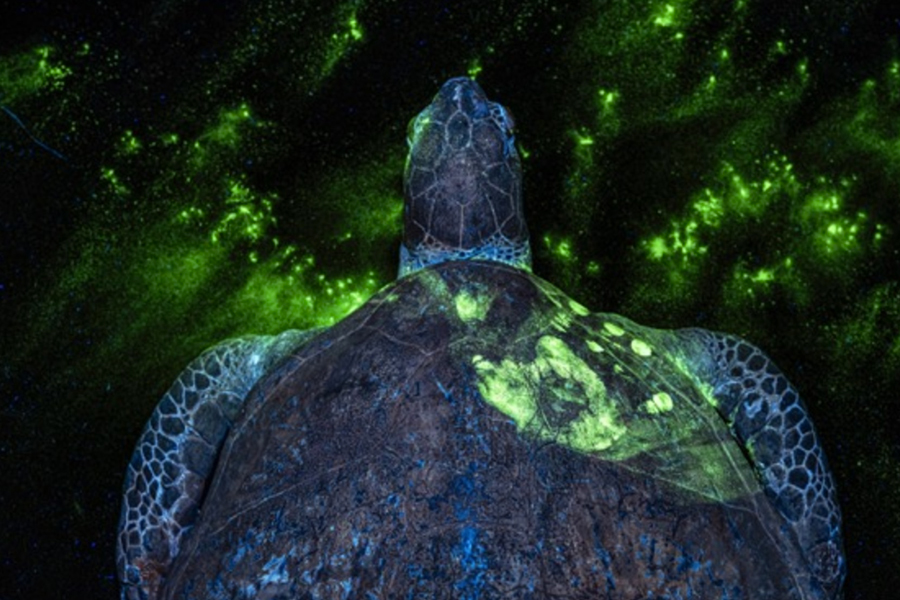
At first glance, the image appears to show a green turtle gliding through luminous water. However, closer inspection reveals a human handprint dusted with forensic powder under ultraviolet light.
Speaking to Positive News, Jaschinski said that the image was created to “expose the traces we leave behind and to demonstrate how science is becoming a vital tool in protecting wildlife from exploitation.”
Developed by specialists at the UK’s Wildlife Crime and Forensics Unit, the technique exposes fingerprints, blood, bodily fluids, and gunpowder residue on animal skin and wildlife products, allowing law enforcement to track individuals and dismantle syndicate networks with unprecedented accuracy.
How is forensic science used to stop illegal wildlife poaching?
Forensic investigation methods are proving to be a game-changer in locations where traditional DNA testing is far too costly or impractical. Alongside ultraviolet detection, forensic investigators from London’s Metropolitan Police have developed magnetic powders to retrieve human fingerprints directly from confiscated animal parts.
A white variant of the magnetic powder is now being deployed to recover human prints from pangolin scales and rhino horns, extending protection across multiple heavily targeted species.
The low-cost, field-deployable technology is already yielding immediate results on the ground. More than 200 fingerprinting kits have been distributed to border forces across 40 countries in Africa and Asia.
In Kenya alone, evidence gathered using a single kit led to 15 arrests, including five police officers, alongside the seizure of 11 elephant tusks. Rather than just proving a crime occurred, confiscated ivory is now directly identifying the perpetrators.
The award-winning Handprint on Sea Turtle photo
Jaschinski’s photo has recently won the Grand Prize at the Prince Albert II of Monaco Foundation’s Environmental Photography Award 2026, having previously secured victory in the Earth Photo 2026 competition held by the Royal Geographical Society.
Sergio Pitamitz, an award-winning wildlife and conservation photographer, and National Geographic contributer, took on the role of Contest Chairman for the Environmental Photography Award 2026. In a press release, Pitamitz praised the photo, highlighting how “Britta Jaschinski has made the documentation of crimes against wildlife a central focus of her work.”
He applauded the photo for demonstrating an innovative method of fighting poaching, along with how the photographer “avoids graphic or sensational imagery.” Instead, he says, she produces “photographs that communicate clearly and effectively to a wide audience, including younger generations, who will play a key role in shaping the future of our planet.”
The shortlisted images from the 2026 Environmental Photography Award are currently on display on the Promenade du Larvotto in Monaco until 30 July 2026. After this date, the exhibition will start on an international tour.
Original source: https://www.veganfoodandliving.com
https://www.animalagricultureclimatechange.org/vegan-women-troop-take-down-poachers-in-africa/