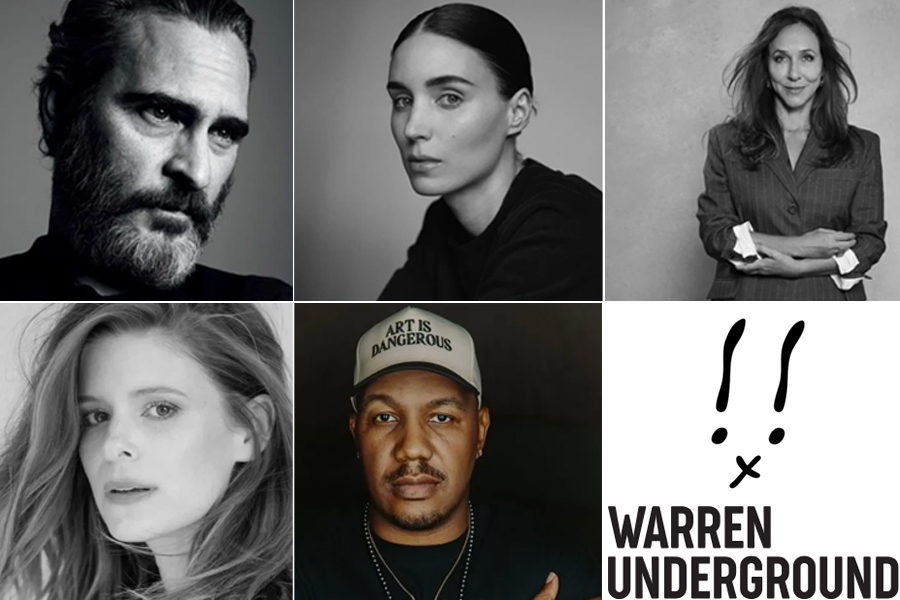
Warren Underground is working to expose the impacts of industrial animal agriculture and has recruited celebrities (including Joaquin Phoenix and Rooney Mara) to spotlight that work.
In the spring of 2020, Joaquin Phoenix had an Oscar and a stack of requests waiting on Michelle Cho’s desk. Phoenix had just won Best Actor for “Joker” at the 92nd Academy Awards, and Cho, who spent two decades pairing high-profile talent with animal-welfare campaigns, was helping Phoenix decide which causes deserved his recently amplified voice. One request had come from Release Aging People in Prison, a grassroots campaign that works to end mass incarceration and advance racial justice by freeing older people serving long sentences.
Cho, by her own account out of her depth on the issue, encouraged Phoenix, who has been vegan since age three and notably used his Best Actor Oscars speech to advocate for dairy cows, to “stick with vegan initiatives.” She reasoned that while the spotlight was on the actor, the animals needed every bit of it to shine on their plight.
“Well, Michelle, this is vegan advocacy,” Phoenix told her, Cho recalls.
That single correction became the founding logic for Warren Underground, the advocacy organization Cho now runs with an Artist Advisory Council that reads like an awards-season table: Kate Mara, Rooney Mara, along with Phoenix, “Blackfish” director Gabriela Cowperthwaite, and Oscar winning comedian, writer, and director, Travon Free. “It was in that moment that I realized that my views on veganism were so facile; and that perhaps the vegan lifestyle had so much more to do with our behaviour than simply what or who we eat,” Cho said.
How Michelle Cho is rebuilding vegan advocacy around behaviour
Warren Underground is working to address industrial animal agriculture as a single system with many doors rather than a debate about diet choice. For years, Cho worked inside organizations fighting factory farming through policy, litigation, legislation, and undercover investigation, and specifically through recruiting celebrities to spotlight that work. The new organization keeps those methods and adds a second aim: teaching consumers to interrogate the food system the way investigators do.
That second aim answers a headwind the vegan advocacy movement keeps hitting: asking people to simply go vegan has proven to be a leaky strategy. According to 2023 Gallup research, only 4 percent of Americans identify as vegetarian and 1 percent as vegan – figures that have barely moved since 2012 and slipped from the 6 percent who claimed the label in 1999, even as plant-based products flooded shelves.
The market has cooled alongside the diets; United States retail sales of plant-based meat and seafood fell 12 percent in 2023 to $1.2 billion, according to the Good Food Institute, while the share of households buying them slipped to 13 percent. Identity-based appeals ask people to brand themselves before they understand the system, and Warren Underground leads with literacy on the wager that a consumer who grasps how food is produced makes choices that outlast any trend or label.
“From the time we are born, we are taught to accept societal, cultural, and religious norms,” Cho said, and questioning those norms has long been treated as a radical act. What critical thinkers keep uncovering when they dig, she argues, are systems of propaganda built to benefit a few while vulnerable populations – both human and animal – absorb the harm. The environmental cost of a product, the conditions of the people who made it, the animal-welfare record behind it, and what happens after it leaves the shelf all deserve the same scrutiny. Warren Underground frames every product around three questions: who profits, who benefits, and at what cost? Success, in Cho’s view, looks like “a consumer base that’s harder to fool.”
Factory farming is among the most intersectional issues of the moment, Cho says, difficult to discuss in isolation. “Factory farming, food literacy, and workers’ rights and safety aren’t separate conversations; they’re facets of the same system,” she says.
Approaching those topics from the audience’s own vantage point, she added, how they eat, what they know, and who is affected, makes them more personal than abstract policy fights. As a young organization, Warren Underground expects to expand into adjacent areas as its resources grow.
Warren Underground uncovering factory farming’s hidden health crises
The organization’s first public project put that thesis in front of a Hollywood readership. For Mental Health Awareness Month, Phoenix published an opinion piece in Variety titled “The Mental Health Crisis Hidden Inside Factory Farms.” The essay turned the usual focus away from eating animals and toward the workers who kill and process them.
“Mental Health Awareness Month allows us to openly discuss the emotional wellbeing of a group who touches countless lives but remains largely invisible: the factory farm and slaughterhouse workers whose daily labor quietly sustains the nation’s food supply,” Phoenix wrote. On any given day, he noted, a single worker may handle hundreds or thousands of animals at a pace set by production quotas, in environments where suffering is normalized. “Research and firsthand accounts have linked this kind of labor to heightened levels of anxiety, depression, emotional numbing, and symptoms consistent with post-traumatic stress,” he noted.
The research supports him. A 2021 systematic review published in the journal Trauma, Violence, & Abuse examined 14 studies and found that slaughterhouse workers reported lower psychological wellbeing than comparison groups across the board. Phoenix also pointed to who bears that toll, describing a workforce weighted toward undocumented people, migrants, and other marginalized workers who face language barriers and fear of retaliation, making it nearly impossible to raise concerns about conditions or their own mental health.
That toll is one of the system’s less visible costs, buffered by the distance between consumers and how their food is made. The numbers are stark. Nearly all of it happens at industrial scale: 99 percent of farmed animals in the US, roughly 10 billion land animals, are raised on factory farms, according to Our World in Data’s analysis of USDA Census of Agriculture figures.
That concentration is also a human health story. Three of every four new or emerging infectious diseases in people originate in animals, the Centers for Disease Control and Prevention reports.
Roughly 70 percent of the medically important antibiotics sold in the US go to livestock rather than people, the Environmental Working Group found in its analysis of FDA data, accelerating the drug resistance that threatens those medicines for human use. The World Health Organization classifies processed meat as carcinogenic to humans and red meat as probably carcinogenic, estimating that each 50-gram daily serving of processed meat raises the risk of colorectal cancer by 18 percent.
Tunnelling toward change
The name, Warren Underground, arrived after Cho studied rabbits. They move and conduct their lives through warrens – or complex underground tunnels. “Warrens can shelter multiple generations of a single family,” Cho said. The more she studied them, the more the architecture struck her as a solution for talking about complex issues. “I wanted to model our organization’s tenets just as carefully,” she said.
The challenge Warren Underground takes on is the space that keeps that system intact, since most Americans never see their food being made – a process the industry has every reason to keep hidden. Phoenix wrote in Variety that the Trump administration had proposed new rules to increase slaughter speeds, a change that would deepen the strain on workers and animals at once. The opportunity, in Cho’s framing, is a public already turning skeptical of that arrangement, paired with visible collaborators who can carry the evidence past policy circles and into everyday conversations about dinner.
The council Cho assembled brings documented advocacy records, not just recognizable names. Cowperthwaite directed “Blackfish,” the 2013 documentary that reshaped public opinion on marine-park captivity. Free became the first Black filmmaker to win the Oscar for live-action short for “Two Distant Strangers,” then executive-produced “The Smell of Money” alongside Kate Mara, a film about a North Carolina community living beside a large-scale pig operation. Rooney Mara and Phoenix, longtime plant-based advocates, executive-produced the 2022 documentary “The End of Medicine,” which traces animal agriculture’s role in pandemic risk.
Cho says the conversation with Phoenix that started everything remains her proof that a famous voice, aimed carefully, can redraw an entire argument. She says the council members have all moved “so successfully” throughout their careers in bringing important issues like these to the table.
“They also happen to be some of my most cherished friendships,” Cho says, “and we look forward to creating more opportunities to shed light on industrial factory farming—a modern day disaster.”
Original source: https://vegnews.com
https://www.animalagricultureclimatechange.org/vegan-celebrities-own-words/