Costly, harmful and addictive – the consequences of excessive nitrogen fertiliser use for our environment, economy, and communities.
There is a story about nitrogen fertiliser use that proponents love to tell – it begins with an early 20th century scientific breakthrough by two German chemists and ends with the claim that synthetic nitrogen fertiliser use has helped us feed the world.
But, unfortunately, a few chapters have been left out.
As a freshwater ecologist who deals with the environmental fallout of excessive nitrogen fertiliser use every day, I wanted to fill in the gaps so the discussion is grounded in a better understanding of the consequences of excessive nitrogen fertiliser use for our environment, economy, and communities.
On July 2, 1909, in a laboratory in Karlsruhe, Germany, Fritz Haber and a colleague began a small experiment that would change the world. Using nitrogen, hydrogen and a rare metal catalyst, they produced a slow trickle of liquid ammonia.
Industrial chemist Carl Bosch refined the discovery into the Haber-Bosch process, first used commercially in 1913. Haber’s motives had nothing to do with feeding the world. Germany relied on nitrate from Chile’s Atacama Desert for explosives, a supply Britain could cut off. Haber hoped a synthetic alternative would give Germany a military advantage. It didn’t, but it did give the world something he never intended: a virtually unlimited supply of synthetic nitrogen fertiliser.
Many proponents of synthetic nitrogen fertiliser position this as the beginning of a story with a happy ending – we went on to use synthetic nitrogen to boost agricultural production and can now credit it with feeding nearly half the world’s population.
They argue that regulation of nitrogen fertiliser use in New Zealand would threaten food supply, increase food prices and lower export earnings. It’s a compelling argument, but it’s not the full story.
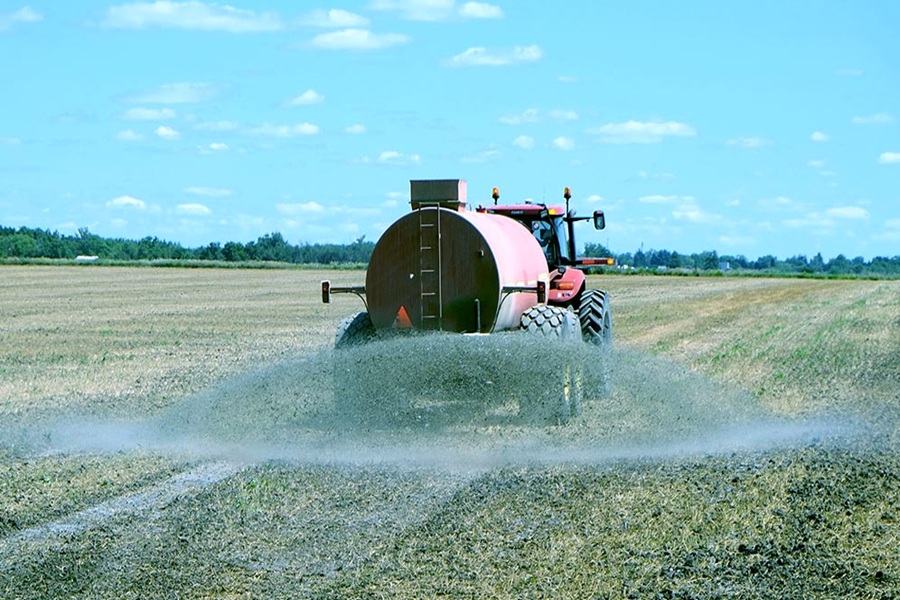
Yes, there is a need for nitrogen fertiliser in some parts of the world, but not typically in New Zealand, where our productive land loses on average more than 150kg per hectare of applied nitrogen each year.
Any discussion about the costs of reducing nitrogen fertiliser use also needs to consider the costs we already face from using it in excess. Increasing nitrogen pollution in our lakes, rivers and coastlines is the proof that just because synthetic fertiliser grows a large share of the world’s food, doesn’t mean we’re using it well.
More nitrogen means more algae, and more algae blooms. A little nitrogen can help native biodiversity in very low-nutrient lakes such as Taupō, but it doesn’t take much more than that to throw a lake out of balance and push out native fish.
Here is the number that should stop us in our tracks: of the 115 million tonnes of nitrogen fertiliser spread on crops and pastures worldwide each year, more than 75 million tonnes never make it into a plant.
Although that global figure accounts for some countries, including Paraguay and Fiji, that need more nitrogen to produce their crops, New Zealand is at the other end of the scale. We are among the worst (12th out of 193 countries) in the world for losing nitrogen.
The data shows we’re using too much, and much of it is moving through soils into rivers, lakes and coastlines. In New Zealand, more than 90 percent of our lowland lakes now have poor or worse water quality, driven in large part by nitrogen and phosphorus entering them from surrounding productive land where nitrogen fertiliser is applied. We are now having open discussions about drinking water being unsafe – a scenario that would have seemed alarmist not so long ago.
I grew up in Rotorua, and Tarawera was my favourite lake. During my childhood in the 1990s, it held a particular kind of mystique.
Had anyone ever found the bottom? Were there really eels as big as power poles lurking down there? Those were the questions fascinated many of us.
What never seemed in doubt was the quality of its water.
With seven-eighths of the catchment around Tarawera covered in native forest, clear water felt almost guaranteed. But the lake sits below seven other lakes and is connected to them by slow-moving groundwater. Some of those upstream catchments have experienced substantially more agricultural development.
Such is the reach of nitrogen pollution that even Tarawera is now growing more algae, partly because of excess nitrogen moving through catchments that are largely invisible from its shoreline.
A few years later, visiting the Ashburton Lakes in the Hakatere Conservation Park in Canterbury for the first time was another formative experience. Their clear water, framed by tussocklands and mountains, made me realise there were lakes every bit as beautiful as those of the central North Island.
Fifteen years later, relatively small areas of agricultural intensification within those catchments have had a dramatic impact. Lake Heron, for example, shifted from being oligotrophic, with good water quality in the A band, to eutrophic, with poor water quality below the national bottom line. The speed of that decline shows how little room for error these naturally low-nutrient lakes have.
While people are discussing the potential economic costs of using less nitrogen, it is important to consider the observed costs of using too much.
Lake Taupō provides perhaps the clearest case study of what this damage can cost. From the 1990s, nitrogen leaching from farms and septic tanks threatened to tip the lake’s famously clear water into decline, so the government stepped in with a catchment-wide nitrogen management plan.
The price tag was $81 million to keep just 170 tonnes of nitrogen a year out of the lake. Spread over the 50 years the plan is expected to operate, that works out to roughly $9500 per tonne each year, more than 10 times the approximately $888 per tonne it costs to buy nitrogen fertiliser in the first place.
Run the same maths globally and the picture gets starker still: at $888 a tonne, the 75 million tonnes of nitrogen we lose to waterways every year represents around NZ$66.6 billion in wasted fertiliser, before we’ve spent a single dollar cleaning any of it up.
That imbalance is the real story advocates for nitrogen fertiliser use often leave out. Nitrogen pollution isn’t simply the unfortunate cost of cheap food. It costs us at every step: we pay to buy the fertiliser, we pay again when it’s wasted, and then we pay far more again to mitigate the damage once it reaches our waterways.
Looking to the past can show us what a lower nitrogen input primary sector could look like. New Zealand’s own agricultural success wasn’t built on synthetic nitrogen at all. The rapid growth between the 1940s and 1990s that is being referenced in graphs circulating online is real, but in New Zealand, this period of growth was underpinned by clover and other nitrogen-fixing plants, not synthetic fertiliser.
New Zealand imported phosphate to help clover fix its own nitrogen from the air for free; close to 90 percent of the nitrogen used in our farming came from natural sources over that period. It’s only since the 1990s, alongside the expansion of dairying, that New Zealand’s use of synthetic nitrogen has climbed, on top of those existing natural sources, at exactly the time global use has begun to taper off.
None of this is an argument against feeding the world, but New Zealand is just not one of those. I’d argue that if we’re going to use it, we should use much less and ensure it remains where it counts, which is in the plants and soil, and not in the lake.
New Zealand’s own history shows we can run a prosperous primary sector without using more nitrogen than our land and water can handle. The only question is whether we manage that nitrogen deliberately, or keep paying, many times over, to clean up after we don’t.
Original source: https://newsroom.co.nz
https://www.animalagricultureclimatechange.org/spain-bans-use-of-fertilizers/